

The recent episcopal consecrations by the Society of Saint Pius X without papal mandate caused an automatic latae sententiae excommunication to the ordaining bishops and the ordinands. The Decree of Excommunication released by the Holy Office also clarifies that all priests and lay faithful who formally adhere to the Society are hereby schismatics.
Thus, the words, “excommunication” and “schism” are once again in the lively vocabulary of online semi-canonists and theologians. But what do these words really mean? And how can one be excommunicated?
In this article, we will shed light on these questions. However, we will not be discussing the specificity of the case of the SSPX. That merits a more detailed and spiritually mature article that I think still needs time and prayer before writing. So, if you are here for my opinion on the subject, then I am sorry to disappoint you.
You can use this Table of Contents to jump to the question you like to read first:
Penalties and sanctions in Canon law
The Catholic Church’s daily life and order is maintained by Canon law. Unlike civil law, the ultimate goal and supreme rule of ecclesiastical law is salus animarum (the salvation of souls). Thus, sanctions and penalties must be read in this light.
Book VI of the 1983 Code of Canon Law is dedicated to delicts and penalties. Can. 1312 clarifies that sanctions in the Church are either (1) medicinal penalties or censures; (2) expiatory penalties; or (3) remedies and penalties.
The immediate goal of medicinal penalties or censures is the rehabilitation of the offender, can. 1347 establishes that this is done if the offender has ceased in doing the offense, has repented of it and has repaired the damage and scandal it caused. Thus the duration depends on the offender himself.
The finality of expiatory penalties is the reparation of the damage caused to the ecclesial community while penal remedies are not really penalties in the strict sense.
Thus, it is wrong to say excommunication or any other sanction given by the Church is a vindictive act. Rather, it is an act of charity or of fraternal correction, if you will.
What excommunication is and what is it not?
An excommunication falls into the first category of sanctions. Thus, it is technically called a censure. It is the principal and severest censure that deprives the guilty Christian of all participation in the common blessings of ecclesiastical society and is thus reserved only to the gravest offenses.
It is medicinal in nature and as such is designed to “shock” a person’s conscience, encourage them to repentance, and ultimately lead them back to full communion with the Church.
Censures cannot be imposed neither in perpetuity nor for a determined time since its duration depends on the fulfillment of the above-mentioned requirements by the offender.
The Catechism of the Council of Trent (Art. IX) describes: “excommunicated persons, because excluded by [the Church’s] sentence from the number of her children, belong not to her communion until restored by repentance. But with regard to the rest; however wicked and flagitious, it is certain that they still belong to the Church.”
Pope Leo X, in Exsurge Domine (1520), condemned Martin Luther’s twenty-third proposition that states that excommunications are merely external punishments and not spiritual. Pius VI reiterated this condemnation in Auctorem fidei (1794).
Clement XI, in his condemnation of Pasquier Quesnel’s Jansenist theses in Unigenitus (1713), asserts the Church’s authority to excommunicate and invalidates the counterargument of a hypothetical “unjust excommunication” that does not separate the excommunicated to the Church and that “to suffer in peace an excommunication and an unjust anathema rather than betray truth, is to imitate St. Paul; far be it from rebelling against authority or of destroying unity” (thesis 92).
In other words:
An excommunication is not:
- A vindictive act of ecclesiastical authority;
- A proclamation of eternal damnation;
- A merely external punishment with no spiritual consequences;
- An act that becomes “invalidated” because it is “unjust”, or that its spiritual effects are not applied because of this supposed “unjust” character.
An excommunication is:
- A penalty or censure reserved to grave offenses whose end is the medicinal, that is, the full restoration of the excommunicated to the Church after fulfilling the above-mentioned three requirements;
- A penalty that separates the excommunicated from the society of the Church and its effects are both in the external forum and the internal forum, thus the effects are both practical and spiritual.
Does an “unjust” excommunication make it invalid?
We have to make an excursus here since we’ve discussed the Jansenist claim that an “unjust” excommunication makes it invalid.
An excommunication is said to be null when it is invalid because of some intrinsic or essential defect, e.g. when the person inflicting it has no jurisdiction, when the motive of the excommunication is manifestly incorrect and inconsistent, or when the excommunication is essentially defective in form.
An “unjust” excommunication is still valid, but it is wrongfully applied to a person really innocent but believed to be guilty. This, of course, means that it is not a question of excommunication latae sententiae and in foro interno, but only of one imposed or declared by judicial sentence (ferendae sententiae).
A null excommunication produces no effect whatsoever, and may be ignored without committing sin. But a case of unjust excommunication brings out in a much more general way the possibility of conflict between the internal forum and the external forum, between legal justice and the real facts.
Pope Innocent III formally admits in De sententia excommunicationis the possibility of this conflict. Some persons, he says, may be free in the eyes of God but bound in the eyes of the Church; vice versa, some may be free in the eyes of the Church but bound in the eyes of God: for God's judgment is based on the very truth itself, whereas that of the Church is based on arguments and presumptions which are sometimes erroneous.
The Pope concludes that the chain by which the sinner is bound in the sight of God is loosed by remission of the fault committed, whereas that which binds him in the sight of the Church is severed only by removal of the sentence.
Therefore, a person unjustly excommunicated is in the same state as the justly excommunicated sinner who has repented and recovered the grace of God; he has not forfeited internal communion with the Church, and God can bestow upon him all necessary spiritual help.
However, while seeking to prove his innocence, the censured person is meanwhile bound to obey legitimate authority and to behave as one under the ban of excommunication, until he is rehabilitated or absolved. Such a case seems practically impossible nowadays.
Who can excommunicate?
Excommunication is either a jure (by law) or ab homine (by judicial act of man, i.e. by a judge).
The first is provided by the law itself, which declares that whosoever shall have been guilty of a definite crime will incur the penalty of excommunication. The second is inflicted by an ecclesiastical prelate, either when he issues a serious order under pain of excommunication or imposes this penalty by judicial sentence and after a criminal trial. We will revisit this later when we discuss latae sententiae and ferende sententiae.
Excommunication is a jurisdictional matter in the Church, thus it follows that whoever has proper jurisdiction can excommunicate but only those subject to him. Subjection here means residence (or quasi-residence) on the territory under the responsibility of the proper authority and by reason of the offense committed in that territory.
For example, a Bishop can only excommunicate those who reside in his Diocese. A regular prelate can excommunicate a religious. But, a parish priest cannot exercise this to his parishioners.
It follows that both de jure and ab homine excommunications can be exercised by the Pope.
Who can be excommunicated?
Ecclesiastical censures can only be applied to those who belong to the Church, i.e. the baptized. A baptized Christian who is a delinquent (who committed the crime) and is contumacious (willfully persists in such conduct) can be excommunicated as a medicine in the hope of repentance.
Thus, non-Christians like pagans, Jews, and Muslims cannot be excommunicated.
Furthermore, no one can be automatically excommunicated of any offense if, without any fault of his own, he was unaware that he was violating a law (cf. can. 1323 n. 2) or that a penalty is attached to the law (can. 1324 §1 n. 9).
The same applies to minors (below 16 years old, those who have imperfect use of reason, those who lack the use of reason (drunkenness, mental disturbance, consumed by passion), those who were forced through grave or relatively grave fear, those who were forced through serious inconvenience or necessity since otherwise will constitute a greater evil, and those acting in self-defense (cf. can. 1324). However, this does not mean that the perpetrator is exempted from penalty, but the penalty prescribed in the law or precept must be diminished, or a penance substituted in its place.
Since it is a remedy, censure is only applied to the living baptized Catholic. The same can be said on its absolution since the penalty ceases at the time of death.
However, the Pope can summon an ecclesiastical tribunal for retrial and rehabilitation of a dead person who was excommunicated while living. If it is proven that the excommunication was unjust, the Church rehabilitates the good name of the person (it is not “absolving” since the person is already dead).
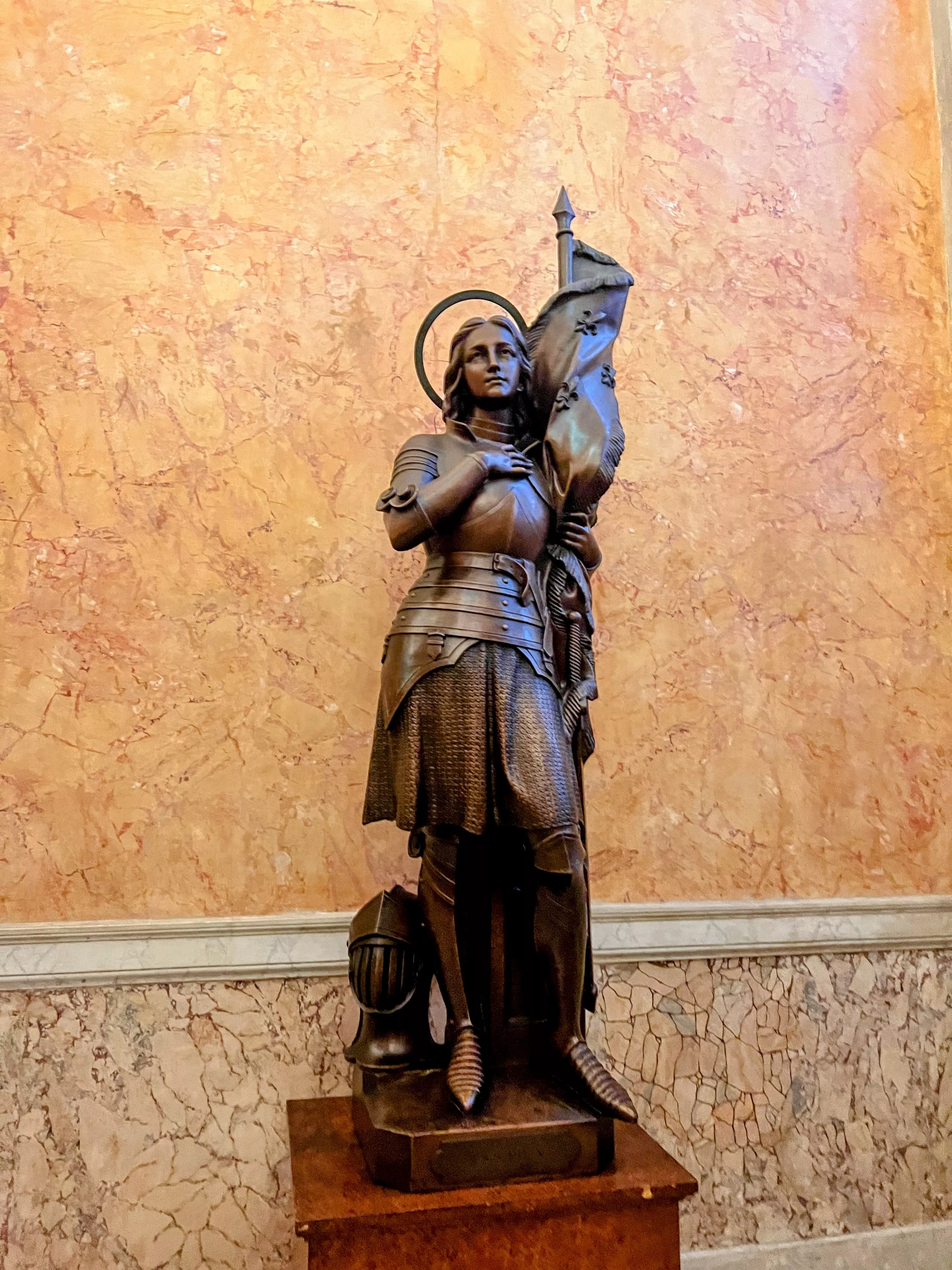
An example of this was St. Joan of Arc who was excommunicated and executed by an ecclesiastical court, heavily influenced by English civil power, in Rouen in 1431. Pope Calixtus III called for a retrial in 1455 to investigate the original trial and its verdicts. On 7 July 1456, the original trial was judged to be invalid due to improper procedures, deceit, and fraud, and the charges against Joan were nullified. She was canonized in 1920.
As a side note, here are other saints, aside from St. Joan of Arc, who received excommunication in their lives:
- St. Athanasius - excommunicated by Pope Liberius who was forced to do so by the Emperor who was favorable to the Arian heresy;
- Pope St. Leo I - excommunicated by Dioscorus I, Patriarch of Alexandria and ten other bishops in the “Robber” Synod of Ephesus in 449 AD (which was later condemned and anathemized by the Council of Chalcedon in 451);
- St. Columba - excommunicated in 562 by the synod of Teltown for allegedly praying for the winning side in an Irish War. The excommunication was later held to be an abuse of justice and the bishops in question removed their charge;
- St. Arialdo - excommunicated by Guido da Velate, Bishop of Milan while he was working against clerical abuses in Milan. He was immediately reinstated by Pope Stephen IX;
- St. Mary Mackillop - excommunicated by Bishop Laurence Sheil in 1871 for insubordination. Five months later, from his deathbed, Shiel rescinded the excommunication.
And, as a “fun fact”, the most excommunicated person in history is Henry IV, Holy Roman Emperor, who holds the record of having been excommunicated five times and by three Popes in his life.
The first person in history to be excommunicated was Simon the Magus who was excommunicated by the first Pope, St. Peter, after trying to buy apostolic powers–thus the name of the sin: simony–(cf. Acts 8:9-24).

What happens to the excommunicated?
Although the excommunicated person is excluded from the society of the Church, he or she still bears the indelible mark of baptism and thus is still subject to the jurisdiction of the Church and must still fulfill his christian obligations though he or she cannot receive the sacraments. Can. 1331 lists the prohibitions inflicted to the excommunicated:
- Celebrating the Sacrifice of the Eucharist and the other sacraments;
- Receiving the sacraments;
- Administering sacramentals and celebrating the other ceremonies of liturgical worship;
- Taking an active part in the celebrations listed above;
- Exercising any ecclesiastical offices, duties, ministries or functions;
- Performing acts of governance.
The excommunicated is also prohibited from the moment his ferendae sententiae excommunication has been imposed or a latae sententiae excommunication declared from benefiting from privileges already granted, acquiring any remuneration held in virtue of a merely ecclesiastical title, and acquiring offices, duties, ministries, functions, rights, privileges or honorific titles.
If the excommunicated insists on defying numbers 1-4, he is to be removed, or else the liturgical action is to be suspended, unless there is a grave reason to the contrary.
What is ferendae sententiae and latae sententiae?
Surely, you’ve heard of these terms after the events of July 1st 2026 and also because I’ve been using these throughout this article. Let us define what these terms mean.
Pope Pius IX promulgated the Apostolic Constitution Apostolicae Sedis in 1869 simplifying the categorization of excommunications and divides penalties into either ferendae or latae.
Ferendae sententiae
A ferendae sententiae is an excommunication imposed by a judge. It is foreseen by the law as a penalty, but only inflicted afterwards. Thus, there should first be a summons of the accused to appear before the tribunal and a trial to confirm if the offense has indeed been committed. If proven guilty, the accused is then invited to recant or else the judge may impose to him the pain of excommunication.
Thus, a ferendae sententiae is not binding upon the offender until it has been imposed (cf. can 1314).
An example of a ferendae sententiae excommunication in recent memory is in 2008 when then Archbishop of St. Louis (USA), Raymond Burke (now Cardinal) excommunicated a woman for simulating the sacrament of Holy Orders.
Latae sententiae
Sadly, latae sententiae is not a type of coffee you can buy in your local coffee shop.
Latae sententiae excommunication is incurred as soon as the act is committed and by reason of the act itself (eo ipso). Thus the offender is excommunicated by the fact itself (ipso facto). The ecclesiastical authority afterwards only declares (not imposes) the excommunication.
Therefore, most headlines are wrong in saying that the “Vatican excommunicates…” Technically, it should rather be: “The Vatican declares the excommunication of…”
Thus, while a ferendae sententiae excommunication is always public, a latae sententiae can be public or occult. For example, a person who committed or assisted in abortion is automatically excommunicated ipso facto even if no one knows. Thus, all the penalties are already applied at the very moment of the act.
When the competent ecclesiastical authorities become aware of the act, they have to make it public by declaring that it has taken place.
Can. 1364-1398 of the 1983 Code of Canon Law (amended by special laws like Sacramentorum sanctitatis tutelam and Vox estis lux mundi) lists the crimes that inflict latae sententiae excommunication as follows:
- Offenses against the Faith and the unity of the Church (apostasy, heresy, or schism);
- Sacrilege against the Holy Eucharist;
- Physical attack against the Roman Pontiff (attacking the Bishop incurs latae sententiae interdict, another type of sanction; attacking a priest or religious or any other lay faithful a just sanction must be imposed);
- Attempting to confer Holy Orders to a woman (both the one who attempts and the woman who simulates receiving the Orders are excommunicated);
- Absolving an accomplice in a sin against the Sixth Commandment;
- Violating the sacramental seal of confession;
- Ordaining without a papal mandate (both the one who confers and the one who receives the Orders are excommunicated);
- Procuring or assisting in abortion;
- Being an accomplice without whose assistance a violation of a law prescribing latae sententiae excommunication would not have been committed.
Other crimes not listed in the Code, but included by other documents and thus inflict latae sententiae excommunication:
- Violation of the secrecy of Papal Conclave;
- Simony and other intents of interfering with the Conclave;
- Communicating the veto of a civil authority in a Conclave;
- Being a member of a Masonic association.
What about other crimes?
You might be asking how about crimes like murder or calumny or sexual abuse. These are also punished by the law, but have their own sanctions not necessarily excommunication. Because of that, we will not discuss them here.
But, suffice it to say that the rule in Canon law is that if civil law can already enforce a punishment, it is not convenient that a person be punished twice for the same crime.
Why are some of those who hold on to Catholic orthodoxy excommunicated while some modernists not?
Can. 1330 states: “An offence which consists in a declaration or in some other manifestation of will or of doctrine or of knowledge is not to be regarded as effected if no one actually perceives the declaration or manifestation.”
There are people who like to walk around the margins of orthodoxy without formally endorsing heres. That is why excommunication cannot be imposed upon them (much less if they do not commit a crime with latae sententiae excommunication).
The competent authority who has jurisdiction, however, can make use of other sanctions to call the attention of these people like suspension or expiatory penalties.
What is the difference between an excommunication and an anathema?
In the dogmatic canons of the Ecumenical Councils of the Church, the word “anathema” signifies exclusion from the society of the faithful because of heresy. It might be said that it is the gravest and harshest condemnation.
Already in the 9th and 10th century, canonists began distinguishing anathema from excommunication, speaking of “major” and “minor” excommunications. The 1917 Code of Canon Law already abandoned the use of these terms (it still exists in the Code for Eastern Churches).
The 1983 Code of Canon Law no longer contains the word anathema so as not to confuse this solemn condemnation of heresy with that of the medicinal nature of excommunication.
What does excommunication “reserved to the Apostolic See” mean?
An excommunication is either reserved or non-reserved. This refers to the one who can absolve the censure. A non-reserved censure can be lifted by any confessor in the Sacrament of Reconciliation.
When the excommunication is “reserved to the Apostolic See”, then it is only the Pope who can lift the censure. When it is “reserved to the Bishop or Ordinary”, then only the Bishop or Ordinary can lift the censure.
In cases of excommunications ab homine (that is, imposed by a judge), the censure can be lifted by the judge who imposed it.
An example of an excommunication reserved to the Bishop was abortion, but in 2016, Pope Francis, in Misericodia et misera, gave all priests, “by reason of their ministry”, the faculty to absolve those who have procured the sin of abortion.”
As always, in the case of danger of death, any priest can remit validly and licitly virtually all penalties (can. 976).
Excommunications reserved to the Apostolic See
The 1983 Code of Canon Law, as amended by Pascite gregem Dei (2021), reserves to the Apostolic See the excommunication of the following:
- "A person who uses physical force against the Roman Pontiff incurs a latae sententiae excommunication reserved to the Apostolic See; if the offender is a cleric, another penalty, not excluding dismissal from the clerical state, may be added according to the gravity of the crime." (can. 1370)
- "Both a person who attempts to confer a sacred order on a woman, and the woman who attempts to receive the sacred order, incur a latae sententiae excommunication reserved to the Apostolic See; a cleric, moreover, may be punished by dismissal from the clerical state." (can. 1379)
- "One who throws away the consecrated species or, for a sacrilegious purpose, takes them away or keeps them, incurs a latae sententiae excommunication reserved to the Apostolic See; a cleric, moreover, may be punished with some other penalty, not excluding dismissal from the clerical state." (can. 1382)
- "A priest who acts against the prescription of can. 977 (absolution of an accomplice against the Sixth Commandment) incurs a latae sententiae excommunication reserved to the Apostolic See." (can. 1384)
- "A confessor who directly violates the sacramental seal incurs a latae sententiae excommunication reserved to the Apostolic See; he who does so only indirectly is to be punished according to the gravity of the offence." (can. 1386)
- "Both the Bishop who, without a pontifical mandate, consecrates a person a Bishop, and the one who receives the consecration from him, incur a latae sententiae excommunication reserved to the Apostolic See." (can. 1387)
By Tradition, excommunication of sovereigns is also reserved to the Apostolic See.
Absolution from excommunication
Again, we have to reiterate: excommunication is medicinal. Its end goal is the restoration of justice and of the guilty to full communion with the Church.
The excommunicated individual is asked to reflect upon the injustice of the act he has committed and to repent truly. The proper ecclesiastical authority can lift the penalties once the offender stops his contumacious act, repents, and restores damages and scandal caused by the action.
Conclusion: is it a badge of honor or an eternal damnation?
No one should be happy when an excommunication is imposed or declared since it means that a great wound has opened in the Mystical Body of Christ.
For the excommunicated, the penalty is not a badge of honor just like how the Jansenists saw it to be. Rather, it is a call by the Church as Mother and Teacher to repent and repair the communion.
On the other hand, it should not be a cause for joy for those who are against the excommunicated or those who remain “Catholics in good standing”. The imposition or declaration of excommunication is not a vindication of one’s own ideology and position. It is not a decree of eternal damnation.
Rejoicing in excommunication of the other constitutes a neo-Donatist attitude, very similar to that of the elder brother in the Parable of the Prodigal Son.
So, in these times of great tribulations against the barque of Peter: the best reaction is to pray. Pray the priestly prayer of Jesus in Gethsemane: “that they may be one.”
In the next article, we will discuss what schism is and what it is not. So stay tuned for that!
Discover more from Tamang Usapan Podcast
Subscribe to get the latest posts sent to your email.


