
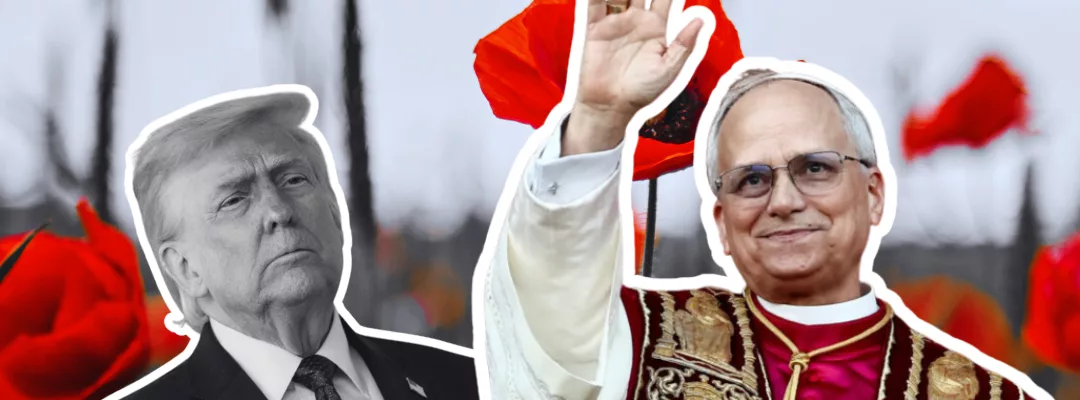
My co-host Russel told me that as good Catholics, we do not need to “stand for” or “defend” the Pope as is common whenever a public attack happens, especially now that a very public spat is happening between the Vicar of Christ and the President of the United States of America. The Pope is the Servant of the servants of God and only needs the Holy Spirit to defend him in public.
I agree with Russel on this. However, I also think that it is still necessary to help modern man to clarify the Pope's position, especially when even Catholics of good faith are now questioning him and warning the Supreme Pontiff that he should “take care of doing theology”.
So, yeah you got it. This will be a piece to tell you why the Pope is right and why this might be Trump’s greatest blunder.
How it all started
Telling you the whole US-Vatican relations, especially the current one, is a job for other pundits and sites. So let us just focus on the immediate cause of this very public spat.
On the 26th of February 2026, the United States of America and the State of Israel attacked the Islamic Republic of Iran. Public communications by the White House stated various justifications: a deterrence from possible Iranian nuclear aggression, a support for the people of Iran who rose up against the tyrannic regime and was put down violently earlier in the year, to secure the region of the Middle East by changing the regime that sponsors terrorism in the area, etc.
The Pope, as Pontifex Maximus, the builder of bridges, called for dialogue rather than arms.
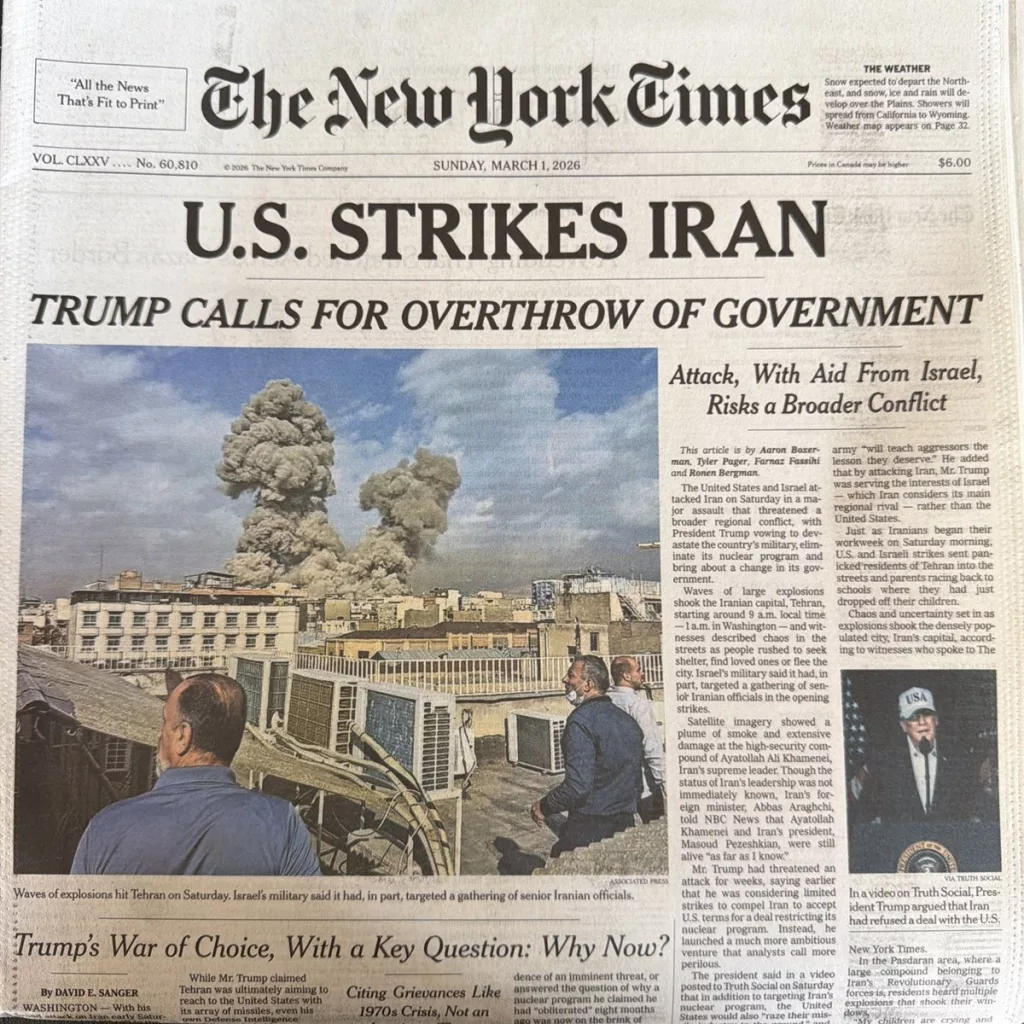
The early days of the war was a tactical victory for the US-Israeli coalition after the death of the Supreme Leader of Iran. However, as the war dragged on and Israel opened another front in Lebanon, tensions began to rise.
The pivotal moment is when the Iranian Revolutionary Guard Corps began blockading the Strait of Hormuz, a vital sea route where most of the Gulf States’ oil trade passes through.
This puts pressure on the global economy and even if the US itself is not so much affected by it as it is also an oil producer, the mounting pressure might have prompted the Trump Administration to force either a faster complete victory or an agreement.
A series of statements
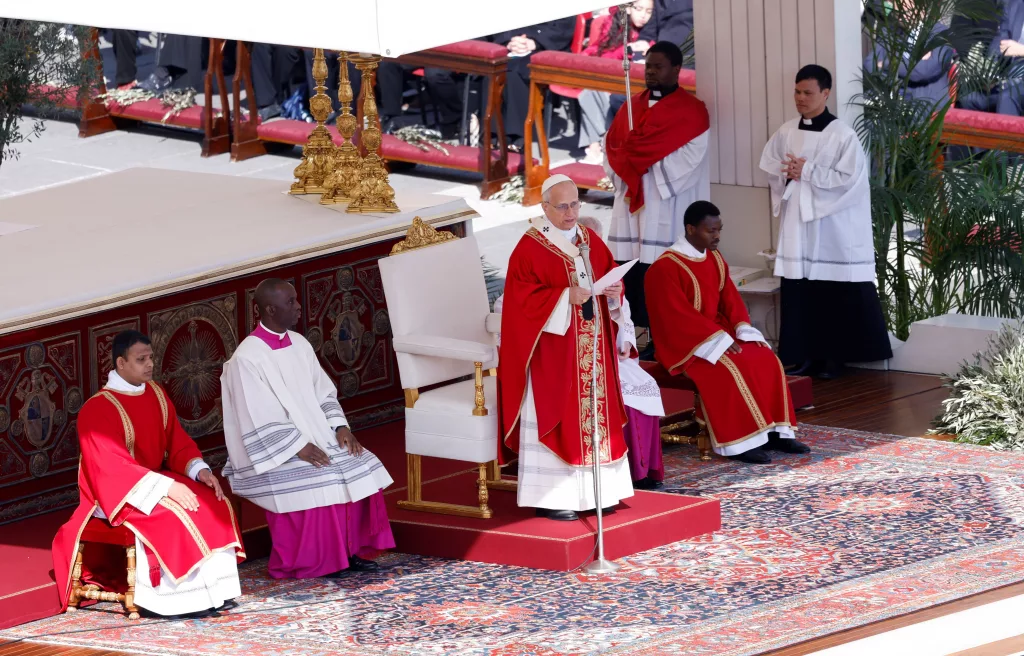
On Palm Sunday, 29th of March 2026, the Holy Father asserted in his homily that Jesus “does not listen to the prayers of those who wage war”.
A few days later, some media outlet reported a supposed meeting in the White House with the Apostolic Nuncio to the US in which, allegedly, an official threatened the Nuncio of a situation “just like when France’s military might have obliged the Pope to reside in Avignon”. This report was refuted both by the White House and Cardinal Pierre, the Nuncio.
As negotiations failed, on the 5th of April 2026, Easter Sunday of the Resurrection of the Lord, while the Pope’s message was: “Let those who have weapons lay them down! Let those who have the power to unleash wars choose peace!”, US President Donald Trump threatened to attack Iranian bridges and power plants and on the next day he warned that “a whole civilization will die”.
On the 7th of April, the Pope, without naming the US President, said that threatening the end of an entire people is “unacceptable”. "There are certainly issues here of international law, but even more than that, it is a moral question for the good of the people," Pope Leo XIV said.
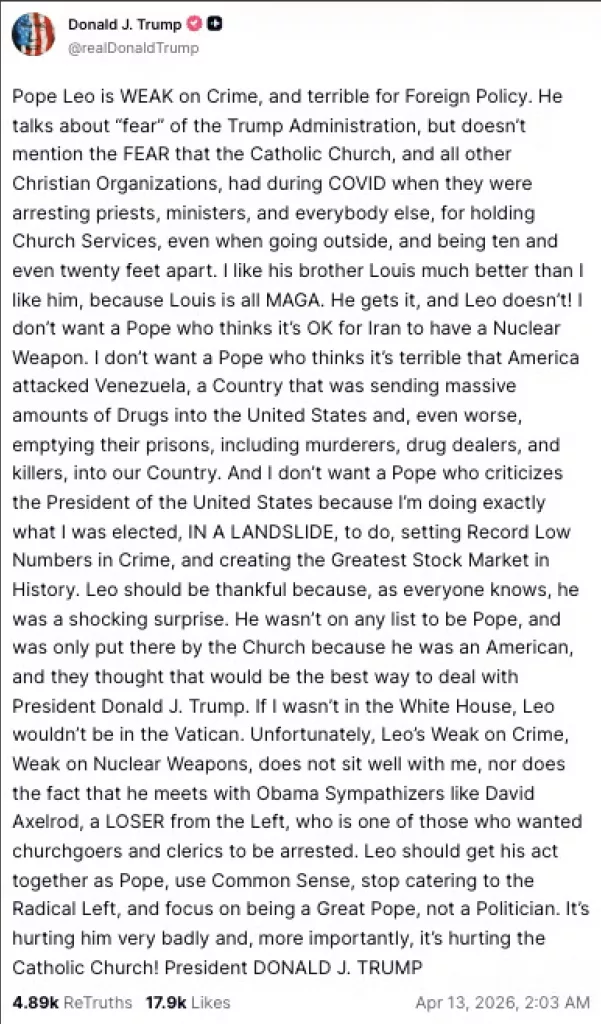
This seem to have irritated Mr. Trump that he lashed out in his Truth Social platform that Pope Leo XIV is “weak on crime” and “terrible on foreign policy” and doubling down on it the next few days saying that the Pope condones Iranian nuclear threat and he could not have been elected Pope if not for Mr. Trump being the President.
The Pope, when asked by the Press about this statement, said that he is not a politician so he is not interested in debate, but he will continue to proclaim the Gospel. Later the same week, he condemned “tyrants who use the Christian message to justify wars”.
Why the Successor of Saint Peter is right
At the heart of this debate is the Just War Doctrine. I will be writing about this topic in more detail in a separate article next week, but if you want to, I highly recommend our two episodes about this topic which you can find here and here.
With that said, the questions, therefore, are as follows: (1) whether or not the Pope is justified in his criticism of the war; (2) whether or not the Pope has the right to condemn those who wage war; and, (3) is the War in Iran justified?
The third one I think should be discussed in detail in the next article that I’ve said above, so let us just focus on the first two.
Is the Pope justified in his criticism of the war?
The evangelical section of the Republican Party was quick to criticize the Pope’s remark that God rejects the prayers of those who wage war as contrary to biblical truth. The traditional catholic section of the same party criticized the Vicar of Christ for not knowing the Just War Doctrine. Therefore, let us ask: is it indeed biblical? And, what about Just Wars?
For the first one, the typical biblical example used is that of the wars that God ordained in the Old Testament like that of Joshua or of David. What this misses is that Old Testament wars cannot be equated with wars done in Anno Domini, that is, in a world after the Paschal Mystery of Christ.
While it is true that God has “commanded” wars in Ancient Israel, we should not interpret it in itself. For the Christian, the OT can only be interpreted in light of Christ. Just as it is not right to use Moses and the Exodus to justify marxist/liberation theology, it is also not right to justify wars with OT wars.
The Church teaches progressive revelation, that is, that God reveals himself to us since the beginning in the Garden of Eden but using a divine pedagogy in which he gradually reveals himself to us meeting us within our historical context until revealing himself fully in Jesus Christ. Therefore, OT wars should be viewed through the lens of divine pedagogy: it was the only way people could understand God’s message in their time.
In fact, if one reviews these “Holy Wars”, the insistence is not on the justification of violence, but rather on the need to trust in God’s might that he himself will resolve the conflict even if everything seems to say the contrary (that is why David was punished after counting his soldiers and Isaiah warned against allying with Egypt or Assyria but rather to only trust God).
In most cases, God’s intervention means that arms were not even lifted just like when Joshua conquered Jericho with its famous walls with only shouts and horns (cf. Jos 6).
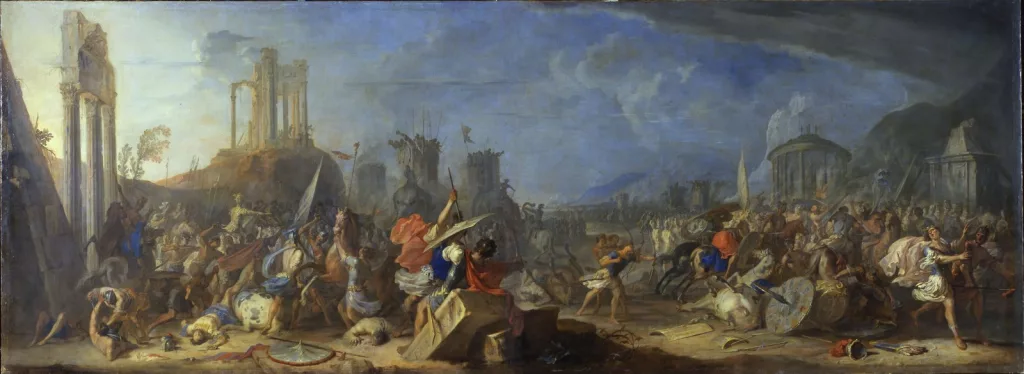
Furthermore, the People cannot enjoy the “fruits” of these wars that is why there is almost always an insistence on burning and destroying everything.
Therefore, OT “Holy Wars” insist on obedience to the Divine command rather than a justification of violence. Origen insists that what we see here is a spiritual allegory in which the physical violence that seems to be prescribed in the OT is actually a “shadow” of the spiritual battle against evil and sin.
God, therefore, never prescribed a war. God is the “Lord, the Giver of Life” and even in the OT, he is recognized to be the only one who can give life and take it back. By affirming that Jesus, the Prince of Peace, “does not listen to the prayers of those who wage war”, the Pope is affirming this biblical truth and condemns those who wage war for their own profit.
What about Just Wars?
The Just War Tradition comes from the biblical reflection of the Church Fathers like, notably, Saint Augustine, on the reality of war and the times that it seems to be inevitable.
As I’ve said before, we will discuss this in more detail in the next article. But for now suffice it to say that a Christian ruler can and should wage war when it is the last thing he could do to protect the Good.
Saint Augustine affirms in the City of God:
“They who have waged war in obedience to the divine command, or in conformity with His laws, have represented in their persons the public justice or the wisdom of government, and in this capacity have put to death wicked men; such persons have by no means violated the commandment, ‘Thou shalt not kill.’”
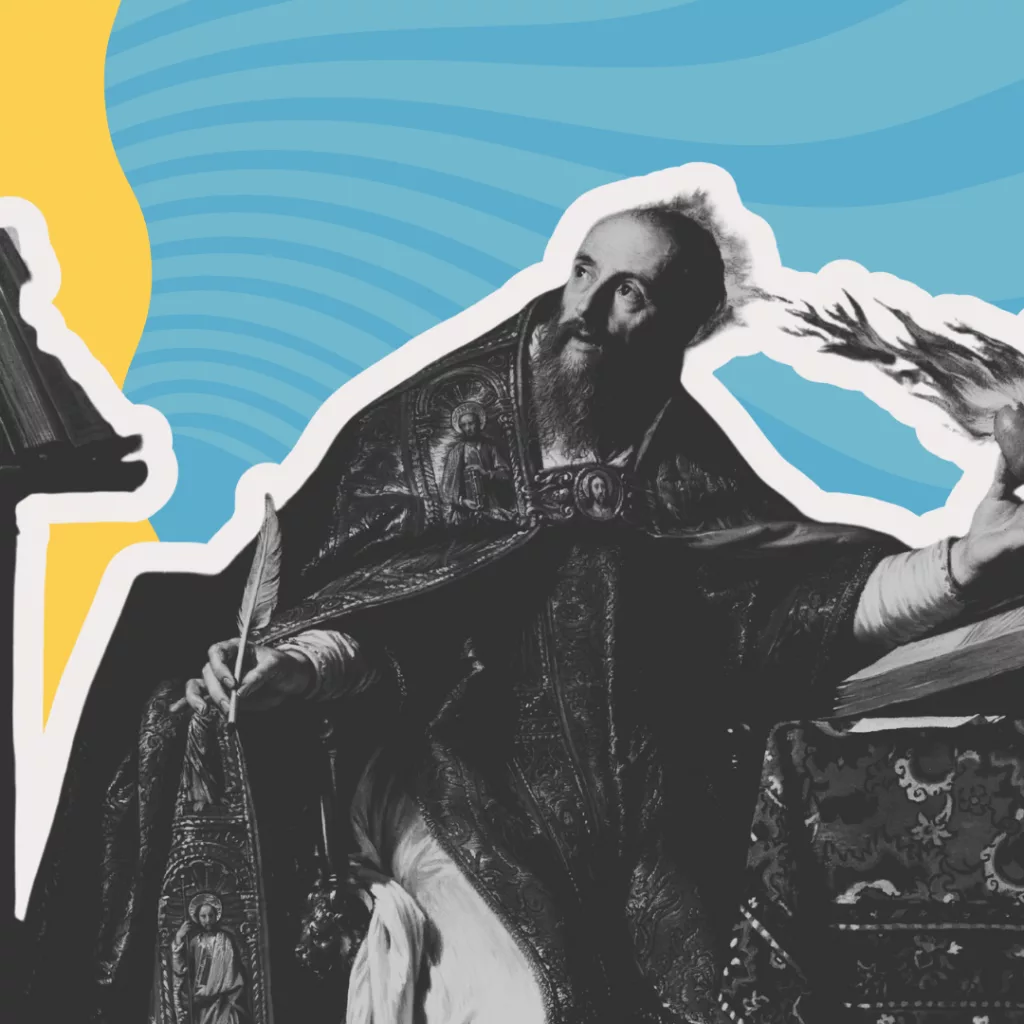
For Augustine, war is justified when it is done in defense of the Good just like a judge does not commit crime when he sends a criminal to prison. This, however, should not be taken as a justification for all State-sponsored violence. Again, it is the last resort.
Saint Thomas Aquinas further develops this by essentially tying Just War with defensive war.
The Catechism of the Catholic Church requires restraint on the use of excessive violence (i.e. things that could end an entire civilization) and that there should exist an objective evil that has caused great harm already.
Therefore, a war waged preemptively because of a perceived threat that has yet to happen cannot be justified.
What about the Crusades?
The rad-trad will now ask: how about the Crusades? Surely, they were wars of aggression, right? Well, to oversimplify it: no, they are not. The Crusades are Just Wars because they are essentially defensive in origin.
Most of the lands the crusaders fought for were Christian lands before the Arab conquest. In fact, during the Crusades most people living in those lands, especially in the rural areas while also maintaining a significant minority in the cities, were Christians.
Türkiye, for example, had a very sizable Orthodox Christian population until the beginning of the 20th century. It was only after World War I and the subsequent nationalist surge when most Orthodox population (mostly of Greek descent) emigrated thus leaving the country with a very tiny Christian population.
Furthermore, the express desire of Pope Urban II (the first Pope to call a Crusade) is the protection of the pilgrims and the Holy Sites in Jerusalem.
Therefore, it is wrong to say that Pope Leo XIV is not considering Just War Theory and its historical precedents. Rather, just like Saint Augustine to whose Order the Holy Father pertains as a priest, Pope Leo XIV is prudent in his understanding of this doctrine not as a free license to kill, but as a very rare card given to a very rare situation of justice.
And so, it is consistent with both the Gospel and the Tradition of the Church to condemn those who wage war and use the Christian message to justify it because wars are not something a Christian ruler actively seeks for, but a begrudging reality he has to assume to protect the Good.
Bonus: The Vice President’s Warning to the Pope
As I’ve said before, we will delve deeper on whether or not the War in Iran is justified or not will be discussed in the next article. So let me end this reflection with what I find as a funny remark by US Vice President JD Vance given on the 15th of April 2026.
The Vice President, a Catholic (and I am sure a very convinced Catholic as his conversion was recent), was asked about the very public spat of Mr. Trump and the Pope. His response can be somewhat summarized as: the Pope should concern himself on moral matters and just as politicians should be careful on their political takes, the Pope also should be careful of his theological takes.
Again, we should not make light of the VP’s faith. He has expressed it so many times before in a very sincere manner. And being a convert does not make him less Catholic as some liberal beige cradle Catholic would like to assume. No. But, his answer is also oblivious to Catholic theology.
First, wars are always a moral matter even if it crosses paths with political affairs. The same is true with other political matters like abortion, divorce, euthanasia, etc. They are still moral matters.
Second, the mission of the Church goes beyond morality. In fact, we only comment on morality not because it is our primary concern but because the truth of Christ demands coherence in life.
Third, the Pope is not a politician. Though papal infallibility does not cover interviews, homilies, or remarks, a Catholic should always take to mind that when the Holy Father speaks on morality and theology, he speaks not as a political demagogue, but as the Vicar of Christ.
Trump’s Greatest Miscalculation
I agree with Bishop Robert Barron’s comment on this matter. While we should be thankful to the Trump Administration because they were very approachable to Catholics (unlike Biden, who was Catholic himself, yet his Administration and partymates were hell-bent in attacking religious communities, spying on TLM faithful, and imposing anti-Catholic and immoral agenda like abortion), we should also admit that Mr. Trump is wrong here.
The danger of our time is the worship of idols. Just like when the Philippines had its tatay, MAGA Catholics in the US run the danger of falling into idolatry because of extreme loyalty to a political figure. One can be a supporter but still awake enough to criticize the one he supports when he objectively commits an error.
Blind loyalty is idolatry. So those who say, “I am Catholic but Leo is not my Pope” should be reminded that they are not. What they are essentially saying is schism bordering idolatry.
Lastly, I think Mr. Trump would be remiss to continue this debacle. It might not be in his character to admit error, but persisting in attacking the Holy Father only alienates the goodwill Catholics have with him.
Analysts have said that it might be because of the anti-Catholic tradition of the US, especially that of the Old Guard of the Republican Party, who sees that attacking the Pope is electorally beneficial or that bewilderment that an American can be more loyal to his faith than to his country (or at least its leaders) that Mr. Trump and his allies continue to attack the Vicar of Christ.
But, this is suicidal. The US is already seeing a quiet revival of the Catholic faith among the young. There is a strong Catholic support to Mr. Trump especially when he went against the anti-Catholic candidates of the Democratic Party (the traditional Catholic preferred party of the US). Alienating this base only weakens his position.
The Caesars had threatened and imprisoned popes. Napoleon threatened the end of the Church. Cromwell hunted down “papists”. Stalin tried to kill Christianity. They are all dead and their empires now a memory. The Barque of Peter still sails.
Discover more from Tamang Usapan Podcast
Subscribe to get the latest posts sent to your email.


