«There is an ontological difference — even before an aesthetic one — between art and what a machine can generate through statistical calculation based on millions of images created by others. Algorithms lack the spark of the human, whereas “authentic culture and art preserve this spark” »
(Pope Leo XIV, Address to Artists and Curators, 2 October 2026)
Beyond the Click: Art, Attention, and the Human Gaze in the Age of AI
How many times have we clicked on an image, an advertisement, or whatever else we find attractive on screen simply because it has managed to capture our attention? What happens to art when every image must first compete for a click? At a time when authentic human relationships are increasingly challenged by the proliferation of clickbait, much of it generated by AI, we are being asked an important question: what kind of vision is our media culture forming in us?
Clickbait and Human Relations
On September 28, 2026, on the Feast of the Archangels, the Dicastery for Communication announced the theme of the Holy Father's message for the LXI World Day of Social Communications: “A New Gaze: Paying Attention in the Age of Clickbait.”
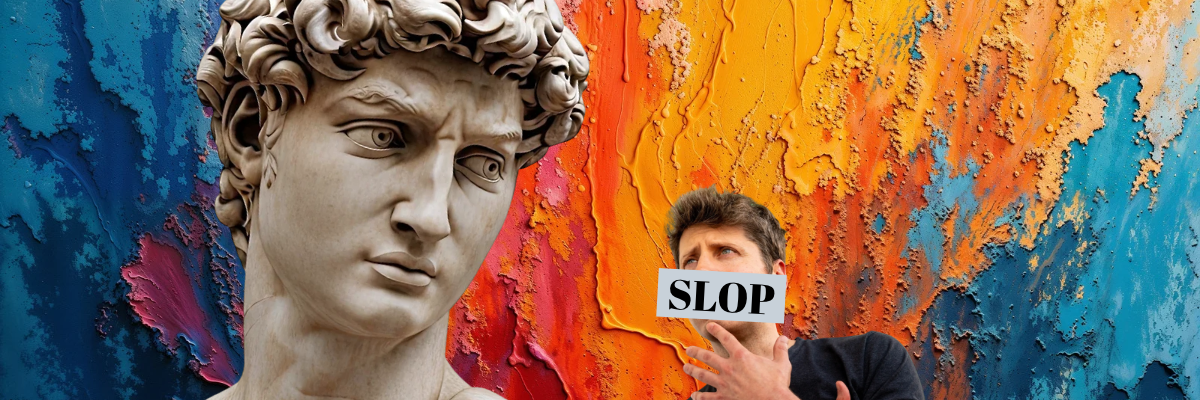
From brain-rotting videos to AI-generated slop, every technological advance seems to make it increasingly difficult for us to work, remember, think, and function independently. Worse still, it can make us appear foolish, as we become less capable of distinguishing what is real from what has been artificially generated. Many of us may have experienced the habit of endlessly scrolling through headlines, thumbnails, synthetic images, short videos, and AI-generated commentary. The issue is not simply that much of this content is sensationalist. Rather, digital platforms increasingly train us to look quickly, react immediately, and move on before encountering anything in depth.
Art Under Attack
Unfortunately, even art is not spared. From AI-generated posters and videos to manipulated images, collages, and personalized posts made to look beautiful by the “AI can do it for me” mentality, artistic expression itself is increasingly drawn into this culture of instant production and consumption.
In his address to artists and curators on October 2, during a meeting organised by the Dicastery for Culture and Education under the theme “The Art of Possibility: Weaving Together,” Pope Leo XIV reminded the participants, comparing art to an antenna, that it «is receptive to the great questions of the human heart - sometimes like a cry, more often like a whisper - and makes them audible, visible and shareable». This observation invites us to reflect on the fact that art is not merely decorative. In keeping with the Church's understanding of this great gift bestowed by the Divine Artist Himself, we must recognize that, through their creativity, passion, and personal expression, artists give voice to something deeply human. Art, therefore, «nurtures the fundamental posture of listening, through which we can learn about humanity’s aspirations and wounds, our thirst for beauty, justice and peace, and our search for meaning».
But, What the F is Clickbait?
Before proceeding further, it is worth making an analytical interlude to examine clickbait more closely. But first, we must ask: what exactly is clickbait?
Every day, particularly in the digital world, we are exposed to an overwhelming amount of information, making it increasingly important for "content creators" to capture and retain users' attention. This is where clickbait comes in. The term, which literally means “bait for clicks,” refers to a strategy commonly used on social media, news websites, and other online platforms to encourage users to click on content through headlines, images, or messages designed to spark curiosity and trigger immediate emotional reactions.
Clickbait is generally characterized by sensationalist headlines, incomplete or ambiguous information, superlatives, and emotionally charged language, often accompanied by provocative or misleading images. Phrases such as “You’ll Never Believe What Happened” or “The Secret No One Wants You to Know” deliberately withhold key information, enticing readers to click in order to discover the rest of the story. Its effectiveness lies largely in human curiosity. When confronted with incomplete or surprising information, we naturally feel compelled to find out more. Digital platform algorithms also tend to favour content that generates high numbers of clicks, likes, and shares, further contributing to the spread of this practice.
However, clickbait is a double-edged sword. While it can quickly increase views, website traffic, and the potential for content to go viral, it can also disappoint users and undermine their trust when the actual content fails to deliver on the headline's promises. It is important, however, not to confuse clickbait with fake news. The two are not the same: fake news primarily aims to spread false or manipulated information, whereas clickbait is mainly designed to attract clicks, even though it can sometimes contribute to the spread of misinformation.
The real issue, therefore, is not simply attracting attention, but rather how that attention is captured. Using clickbait responsibly requires striking a balance between generating interest and accurately representing the content. In a digital environment increasingly driven by competition for attention, authenticity, quality, and credibility remain essential to building communication that is both effective and sustainable in the long term.
AI Generated Clickbait
One danger of AI-generated media lies not only in deception in the narrow sense of the term. It also lies in the production of images that appear meaningful without being grounded in reality or human experience. There is a fundamental difference between a beautiful image, which opens the viewer to reality, and a persuasive image, which uses beauty to elicit a reaction, secure a sale, influence a vote, or generate a click. The central question is not whether AI can produce beautiful images, but whether the images it generates help us see reality more truthfully.
In Defense of Art
Art is not simply another form of content competing in the attention economy. As the South Korean philosopher Byung-Chul Han has observed, art is declining in its cultural force under digital capitalism, while the rise of AI poses further threats to human autonomy and creativity. In particular, in his book Saving Beauty (2015), Han argues that contemporary culture favors a “smooth” aesthetic: frictionless, polished, and immediately consumable images. He sees this tendency as weakening art's capacity to challenge, disturb, or reveal what is different.
Indeed, AI can become a tool in artistic work, helping artists explore new possibilities and even attract attention. However, it cannot, by itself, replace the human dimensions of experience, responsibility, intention, suffering, memory, and encounter that find expression in the creation of an authentic work of art. In his message for the LVIII World Day of Social Communications, Pope Francis warned that we risk becoming a society that, despite being rich in technology, grows increasingly poor in humanity. He reminds us that «only by adopting a spiritual way of viewing reality, only by recovering a wisdom of the heart, can we confront and interpret the newness of our time and rediscover the path to a fully human communication». In other words, communication requires what he calls the “wisdom of the heart.”
Likewise, in his message to participants at the Second Annual Conference on Artificial Intelligence, Ethics, and Corporate Governance last June, Pope Leo XIV urged that AI be evaluated according to its contribution to the integral development of the human person and society, while warning that generative AI raises questions about humanity's openness to truth and beauty. The Vatican document on artificial intelligence, Antiqua et Nova, is also particularly relevant in this regard. It argues that AI must be evaluated in relation to the human person, truth, responsibility, and the common good, while warning that it can also affect humanity's capacity to grasp reality and beauty.
Let us also recall what Pope St. John Paul II addressed in his Letter to Artists: authentic art is a path towards the deepest reality of the human person and the world. It also connects beauty with truth, as beauty can unite generations through shared admiration.
At its best, art is a practice that restores attention to its human depth. In this age of AI, art resists reduction by refusing to reduce a person to a data point, profile, image, or behavioural prediction. It preserves particularity because it pays attention to this face, this body, this landscape, this wound, or this memory. Finally, art creates duration: it invites the viewer to remain present rather than merely producing an instantaneous reaction.
Discover more from Tamang Usapan Podcast
Subscribe to get the latest posts sent to your email.