Mary in the Good Friday Processions
Familiar Scenes of Devotion
Imagine this, dear brothers and sisters: Biyernes Santo ng hapon. Katatapos lamang ng liturhiya sa loob ng simbahan. Lalabas ang prusisyon. Anong imahen ang hindi pwedeng absent sa lahat ng mga simbahan tuwing Good Friday kasama ng Santo Entierro? Si Magdalena ba? Ang Pinatawad na Magnanakaw? Si San Pedro? Ang Nazareno? Wherever and whenever there is a Good Friday procession, you will always find the second most important character next to Christ: his sorrowful Mother.
The Image of the Virgen Dolorosa
Whenever one looks at the image of the Virgen Dolorosa during the Viernes Dolores (Friday before Good Friday) procession, the Viernes Santo Prusisyon ng Paglilibing sa Panginoon and the nighttime procession of the Soledad de la Virgen, it is impossible not to notice her unique figure and painful facial expression—her clothing, no matter how beautifully embroidered or adorned, is dark and gloomy, representing her own suffering as a mother; her eyes, filled with unspeakable sorrow and grief, with tears abundantly flowing on her face; her hands, usually clutched tightly in front of her; the semi-closed or slightly open mouth that seems to be breathing heavily or sighing, or even moaning in pain; her chest, usually adorned with a metal heart pierced by seven swords representing the sorrows she endured.
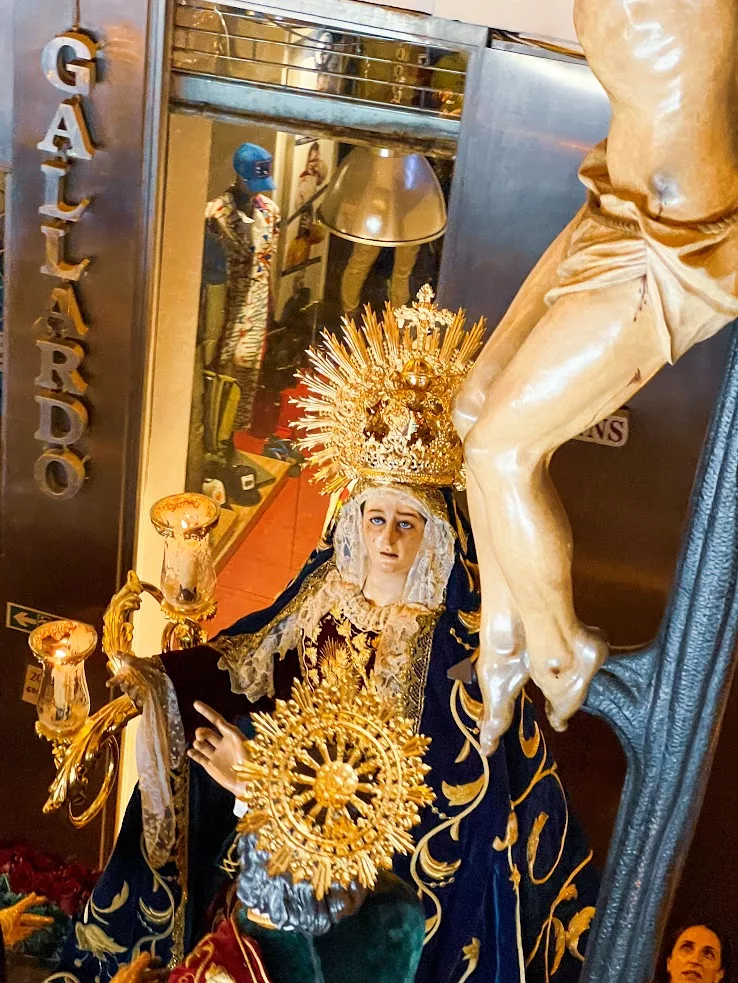
This depiction of the Blessed Virgin Mary has always been familiar to most if not all of us. But, surely, may isang bagay na baka taken for granted natin at hindi man lang natin masyadong napapansin at napagninilayan sa imahen ng Mahal na Birhen Dolorosa. What is her position or posture? What is the significance of such a posture?
The Gospel Foundation: Mary Standing by the Cross
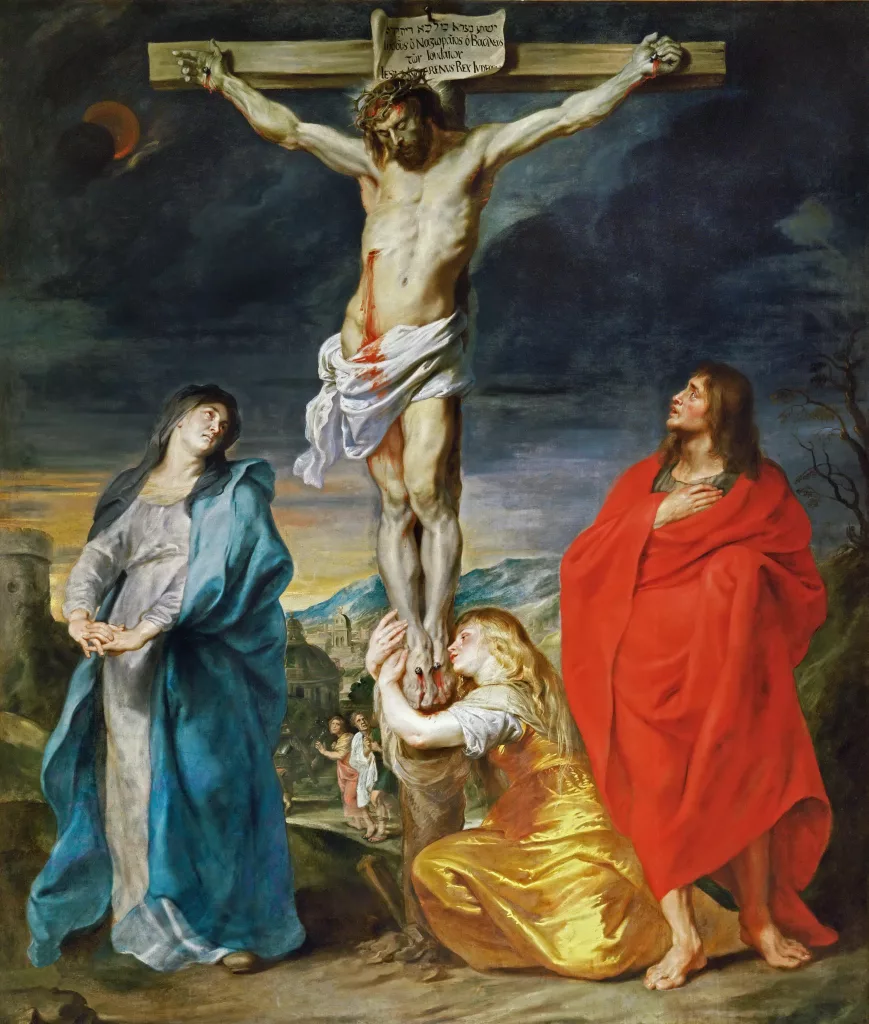
Standing by the cross of Jesus were his mother and his mother’s sister, Mary the wife of Clopas, and Mary of Magdala. When Jesus saw his mother and the disciple there whom he loved, he said to his mother, “Woman, behold, your son.” Then he said to the disciple, “Behold, your mother.” And from that hour the disciple took her into his home. (John 19:25-27)
The Context of Crucifixion
The Significance of Mary’s Posture
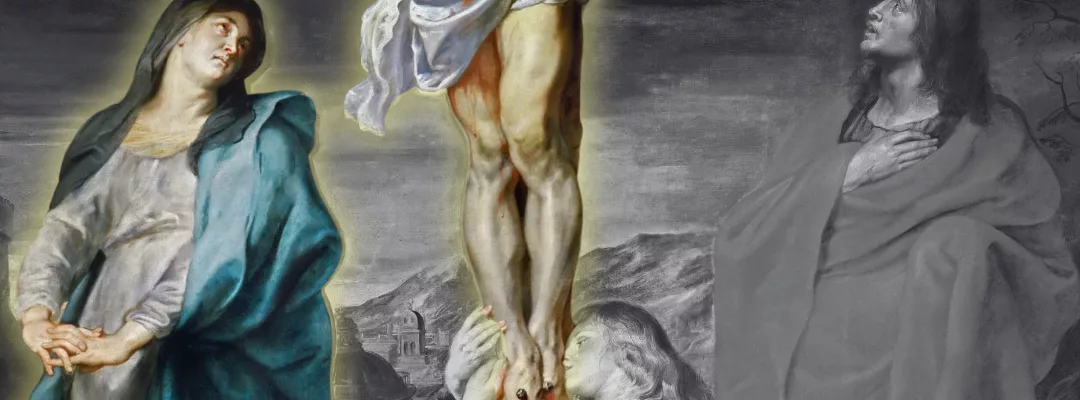
First, let us look at the CONTEXT surrounding the Gospel passage we have just mentioned. The Passion narrative according to St. John mentions the significant posture of the mother of Jesus: STANDING. The evangelist did not surely write it down simply to tell a story and assign an action to a character of the drama. Although minimally stated by the evangelist as it appears in the narrative text, her being situated “by the cross” speaks volumes of her maternal nature, her compassion and above all, her faith in her own Son—she who is his first disciple and most loyal follower.
The Reality of Public Execution
The scenario of the Crucifixion should be clear to us by this time. The cross where Jesus is crucified is already standing above the hill called Golgotha. It also translates to the “Place of the Skull”. The cross displays him in the sight of the crowds. Scenes of human tragedy have always attracted and involved the presence of curious onlookers. That time, the Jews were celebrating the Feast of Passover, hence the presence of vast crowds coming into and bustling around the city and its outskirts.
The Brutality of Crucifixion
The mother of Jesus is described as standing by the cross. To understand the gravity of the circumstances the mother has involved herself in, let us first look at the history and context of Roman execution by means of crucifixion wherein the victim is made to endure long hours of agonizing physical torments, as well as humiliation and loss of honor. Kung napanood po ninyo ang “Passion of the Christ” by Mel Gibson, you already have a clear idea of what I am talking about. During the time of Jesus, death sentence by crucifixion was among the most brutal, and the worst among the capital punishments of the Roman empire.
Mary’s Presence Under the Cross
The Risk of Being There
Now let us go back to the Mother of Jesus under the cross. Why was she there? Bakit siya nandoon? While the answer may seem obvious to us, the situation surrounding public executions such as that of Jesus is not the best scenario to involve oneself into.
The Danger of Identification
According to some scholars, records indicate that the (immediate) families of crucifixion victims could stand near them during their deaths. (As long as they do not create a riot or disturbance while the execution is being carried out. The Roman soldiers were alert and particular about this. Any indication of rebellion or riot could spell disaster and demise on the part of the instigators.]
To identify oneself publicly as related to and standing with the condemned puts one at the menace of persecution and humiliation. We can only speculate on what can possibly happen to Mary as she stood there beneath the cross of Jesus. Maaring pagbabatuhin o bastusin siya ng mga kapwa niya Hudyo, dahil siya ang “Nanay ng rebelde at kriminal na pinarurusahan ng pagpapako.” She could also be insulted, laughed at and harassed by the Roman soldiers, who are known for their brutality and inhumaneness in such situations. In spite of it all, Mary persisted to be with her son despite looming threats and possibilities of suffering with him there.
The Posture of Mary and Its Significance
The Meaning of Standing
Secondly, let us turn our attention to the POSTURE of Mary, the meaning and the significance of such posture. Why is her posture and presence significant? Posture, especially standing, can simply refer to the bodily position. When joined to the idea of symbol, standing becomes an action that embodies a conviction because it transcends bodily capacity and goes as far as expressive of faith, adherence and solidarity.
Women in the Time of Jesus
In Jewish society and culture, most especially during the time of Jesus, women (together with children) were considered simply as second class citizens, hence they are powerless and voiceless. In the case of Mary, standing at the foot of the cross is the only thing she can do.
Mary’s Silent but Strong Message
Among the many reflections on Mary’s posture of standing as she watched her suffering son slowly and agonizingly dying, what stands out as relevant to us today, more than ever, is her unspoken yet strong message:
Sa mundong ito na puspos ng kawalan ng hustisya, may kaya pa akong gawin. Ang tumayo, makiisa at makiramay sa nagdurusa. At hinding-hindi ito kayang agawin o ilayo ninuman sa akin.
Mary and the Kingship of Christ
The Inscription on the Cross
Only a handful of verses before the mentioning of Mary at the crucifixion scene, the inscription ordered by Pontius Pilate to be written and attached to the cross spoke of the controversial title of Jesus (cf. Jn 19:19), which triggered the Jews since the trial as if provoking them even more hence their demand for Pilate to change the contents (cf. Jn 19:21) of the said inscription. Ano ang nakalagay doon? Naaalala pa ba ninyo ang binabasang Pasyon tuwing Viernes Santo?
The inscription ay nasusulat sa tatlong mayor na mga linggwaheng aktibong ginagamit noong panahon ni Hesus: Hebrew, Greek, and Latin. The Latin is the basis of the famous “INRI” inscribed on the upper portion of the vertical beam of our crucifixes: Iesus Nazarenus Rex Iudaeorum (Jesus the Nazorean, King of the Jews).

Mary’s Identification with Her Son
The presence of the mother near the cross is an obvious statement in itself: she identifies herself with the crucified—and everything about him, including his kingship—because he is her son and she is his mother. If the son is king, what would that make his mother? Kung ang anak ay hari, ano ang magiging tawag at estado sa nanay ng hari?
Mary’s presence at the foot of the cross is her own response to what Christ declared in the earlier chapters and verses of the Gospel of John: “Whoever serves me must follow me, and where I am, there also will my servant be.” (cf. Jn 12:26).
The Compassion of Motherhood
Mary as First Tabernacle
Mary's actual physical presence is driven by the natural tendency of motherhood. At the same time, of all people, she had a higher awareness of the divinity of this Divine Word made flesh. She gave birth to him. To the Living Bread from heaven—Jesus—she is his first tabernacle, his home. She is the closest witness of his human development from the womb, his first believer, his first disciple, and servant.
The Comfort of Her Presence
By her presence, even without involving the use of soothing words, the Blessed mother gives comfort and consolation to Jesus suffering on the cross. Her active presence is that of immeasurable compassion that characterizes the uniqueness of motherhood.
Sa ating pang-unawa bilang tao, maaaring dito natin maididiin ang isang kasabihan, but with a twist: “Hindi kayang tiisin ng isang magulang ang kaniyang anak.” In the case of Jesus and Mary right then and there at the crucifixion scene, we can only infer na parehas nilang hindi matiis ang isa’t isa.
The Pain of Mother and Son
Aside from the physical pains brutally inflicted upon him by the temple guards and the Roman soldiers, what most probably adds to the pain of Jesus was the sight of his own grieving mother under his cross. He was all that she had. Si Kristo na nga lang ang mayroon siya, ngayon ay mawawala pa sa kanya. He was everything to her.
The Challenge and Invitation
Mary as Model of Solidarity
Mary, standing at the foot of the cross, shows us that solidarity with the suffering is not passive resignation but an act of faith and courage. Her presence is a prophetic stance against injustice.

A Marian Lens on Social Justice
In a world marked by inequality, oppression, and violence, Mary’s silent but firm standing tells us that there is always something we can do: to stand, to be present, to accompany, to show compassion.
Conclusion and Prayer
Final Reflection
The Blessed Virgin Mary did not speak many words under the cross. But by standing there, she taught us the meaning of Christian discipleship, motherhood, solidarity, and faith.
A Prayer
Allow me, as a conclusion, to share to you the Ave Maria or Hail Mary to Our Lady of Sorrows, attributed to St. Bonaventure:
Hail, Mary, full of sorrows
the crucified is with you.
Most tearful are you among all women
and tearful is fruit of your womb, Jesus.
Holy Mary, mother of the crucified
give tears to us, crucifiers of your Son,
now and at the hour of our death. Amen.
May the Blessed Virgin Mary, Our Lady of Sorrows, protect us and guide us on the way of life.
Discover more from Tamang Usapan Podcast
Subscribe to get the latest posts sent to your email.


