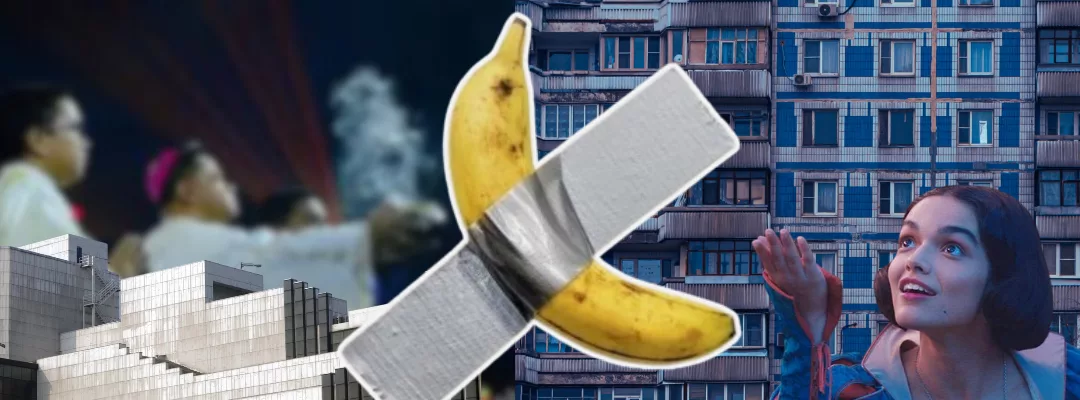
I was watching a BBC (or is it CNN?) report on US President Donald Trump’s renovations in the White House, especially the most controversial East Wing Ballroom. As part of his MAGA movement, Trump is also advocating for a “Make America Beautiful Again” and thus mandated that Federal buildings must follow the classical architecture and not the brutalist style of the post-war era.
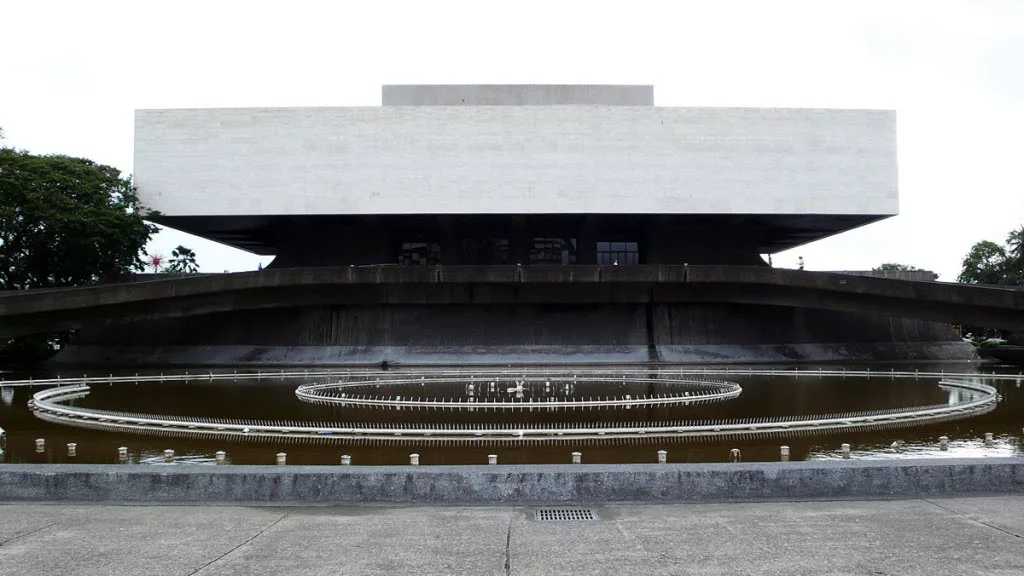
In the very same report, there were defenders of brutalism calling it “democratic” and that classical architecture is favored by tyrants and dictators. Well, in a sense, brutalism is indeed a homage to the “demos”, the people, at least immediately after the war. If you want to know more about brutalism’s philosophy, I recommend you watch Dami Lee’s YouTube video about it. But, still, brutalism is objectively ugly, it is devoid of life just like most of modernity.
A short history of Modernism
Before we answer the question, let us first define what modernism is. In the arts, it refers to the movement or the style that departs from any traditional form. In the Church, it refers to the movement that calls for modifying traditional beliefs, practices, liturgies, and adapting it to modern sensibilities, particularly to the sensibilities of the 20th century (especially the 60’s and 70’s).
To be clear, modernism is not a single movement, rather it is a culture that permeates many parts of society. What we are concerned with here is modernism as we know it today, that is, the product of the post war period. But, it did not just spring out of life just out of nothing. There was already a thirst to reinvent, to “return to the roots”, in the arts, in sciences, in the liturgy as early as the late 19th century.
In the arts, expressionism and impressionism championed by the likes of Monet, Van Gogh, Sargent, etc. are reinventing how we express the world by focusing more on the dance of lights, the fleetingness of the everyday. In architecture, Art Nouveau integrated nature in architecture and later, Art Deco expressed the optimism of technology and the future. In the liturgy, the Liturgical Movement was born in the Monastery of Solesmes intending to revitalize the liturgical life of the Church coinciding with the renewed interest in the Gothic Style. In the sciences, there was a renewed interest in history (you even have St. John Henry Newman being converted after immersing himself in early Church History).
All of these do not really intend to “destroy” or “replace” traditional forms. Rather, they seek to revitalize the traditional forms in their fields.


However, there are also movements that really want to destroy the traditional form. Most obvious is in politics, Karl Marx proposed the idea of socialism, later radicalized by Lenin as communism that, following Hegel’s dialectics, but now in material form, seeks to end all traditional forms of governance (i.e. monarchies).
In biblical sciences, the historico-critical method and liberal christianity arose first in Protestant churches that sought to “demythologize” the Bible, some even coming to the conclusion that most of what is written in the New Testament is just an invention of the apostles.
In religion, there was a movement by the theological elite to reinvent the liturgy and dogma to make the Church more “democratic”, to shy away from traditional forms seen as remnants of a glorious past incongruent with the signs of the times. Thus the language of sacrifice, a regal language was shunned, or at least lessened; the flexibility of the vernacular was preferred than the stability of Latin, and symbols that speak not of the 60’s and 70’s milieu were tucked away in shelves and museums.
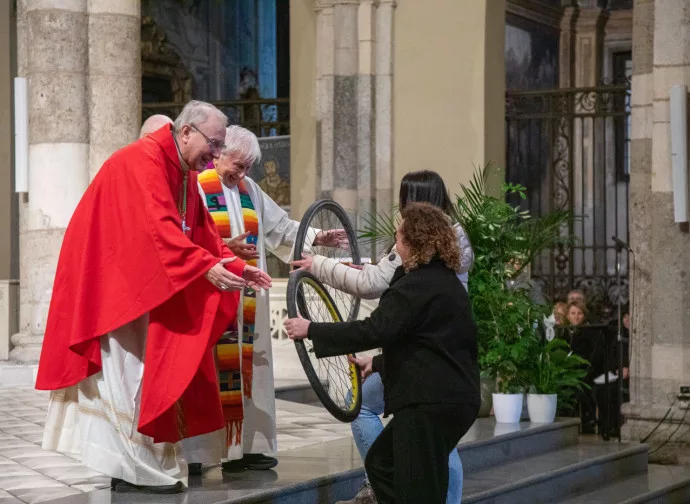
Some, even without official sanction, went further: you have beige Catholicism that reduces the faith to spiritual dopamine “God is love, love wins”, clown Masses, priests preaching about telenovelas or using the pulpit as their concert stage. The Mass is no longer the Holy Sacrifice of Christ the Savior, but the stage upon which the Church seeks to remain relevant to the world.

Post-WWII and the Cold War
This second category of Modernism’s precursors is what triumphed culturally after the two World Wars, especially the second. Most monarchies fell becoming republics either capitalist, socialist/fascist. Regardless of ideology, they regard themselves as “democracies”, the demos rule (that maybe the people who only work for themselves, or some of the people who pretend to work for the “people”, or the people who are the only ones who can call themselves “people”).
The two World War, especially World War II, was the most devastation the Earth saw in its history. So, reconstruction efforts were sorely needed. Brutalism was the ideal solution: fast, cheap, duplicable. The classical architectural arithmetic of firmness + beauty + function has been replaced by firmness + function + low price.
The arts have been reduced to either a propaganda machine by the Soviets or a commodity by the US hegemonic order of the West. Beauty is the least of the concerns. Abstract art which started as just an expression of the artist’s interiority became a commodity that only elites can buy and appreciate.
When you marry the age, you become widowed in the next
But why do we see all of this as fundamentally ugly? Especially the young, my age and those that came after us, the majority of us find these things ugly. Why? I think there are at least two reasons.
The first is that Modernism speaks of a language that we, in our generation, no longer speak. The needs and hopes of the 60’s and 70’s are no longer ours. The beauty of traditional forms of art, education, etc. is that they are “classical” because they are proven and tested throughout the centuries.
Just ask yourself this: why do we still think about the Roman Empire and not about the USSR? The USSR is comparatively a greater world power than the Roman Empire. Even if you answer that it is because of US propaganda highlighting their evil deeds, the Roman Empire too was full of evil actions and was blighted by propaganda by most of their enemies.
Our grandparents embraced Modernism because it was the need of their time. They needed to reconstruct quickly so Brutalism it is. There is no time for art, so abstract it is. There is a fear of what cannot be controlled, so vernacular it is. But, this is no longer our need.
Modernism: a plaything of the elite
The second reason that I see is that Modernism, in all its expression, even if it pretends to be “democratic”, is at heart an elitist endeavor.
Only the “learned” can appreciate abstract art. It takes one’s “artistic eyes” to discern why a banana taped to a canvas cost millions of dollars. Only an architecture student or professional can understand why brutalist architecture is “democratic” and innovative, or why minimalism is a luxury that the rich can have.
Only the theological and ecclesiastical elite can appreciate clown masses and party masses as “pastoral approach” to “bring the Church closer to the people”. Only them can understand why a priest must only wear the “chasu-alb” and the stole when celebrating the Mass in a barrio chapel but can stroll Bonifacio High Street in his Lacoste polo shirt and Levi’s jeans.
“The people will not understand Latin so do not chant in Latin.” How come people we expect to learn algebra and calculus in High School cannot be expected to learn Latin? Well, they will not understand, yes, only if you will not teach them to.
On the political sphere, we are already seeing the ugly face of Modernism. We have trusted the political elite so much to “represent” us that we find it hard to disengage from them. And if we do, the tendency is to look for a “Messiah” figure, a strongman, a tatay who will solve everything, only to turn out the worse of the lot, a demagogue and populist but still as corrupt as the others.
The One, the True, and the Beautiful
Why do we need to make things beautiful again? Why is there a thirst for it, especially among the younger generations? I remember a middle aged priest that visited us once commented, “Why do young priests like to wear those silly vestments and celebrate the Mass facing away from the people? It does not make sense!” Indeed, why?
Hans Urs von Balthasar said that it is Beauty, not the Truth nor the Good, that will first capture our attention. You begin to fall in love with someone because you see something beautiful in them, may it be their physical appearance or some quality that they have. You are attracted to it.
In religion, that will be the liturgy. You become attracted to its symbols and rituals. But, it does not end there, Beauty will lead you to the Good, i.e., the moral life. If you are really attracted to what is going on in the altar, it will slowly but surely mold you to live a life consistent with it. And the Good will ultimately lead you to the Truth, to dogma.
Going back to the allegory of falling in love with someone: after being attracted to his/her physical appearance, you learn to treat the other person as a person. And love enters when you come to the conclusion that that person is the only one TRUE person for you.
Why do we thirst for beauty in this ugly world? Because without it we cannot really know the good, and that is why our moral code in Modernity has always been utilitarian/pragmatic. Without the Beautiful and the Good, we cannot arrive at the Truth, and that is why our society is drunk with relativism, fake news, and ideologies.
Without the Beautiful, the Good, and the True we cannot arrive at the One, God himself, and that is why ours is a “fatherless generation”. Nietzsche’s fool is indeed right, we have killed God, not because he is metaphysically dead, but because we killed Beauty that ultimately leads to him.
Discover more from Tamang Usapan Podcast
Subscribe to get the latest posts sent to your email.