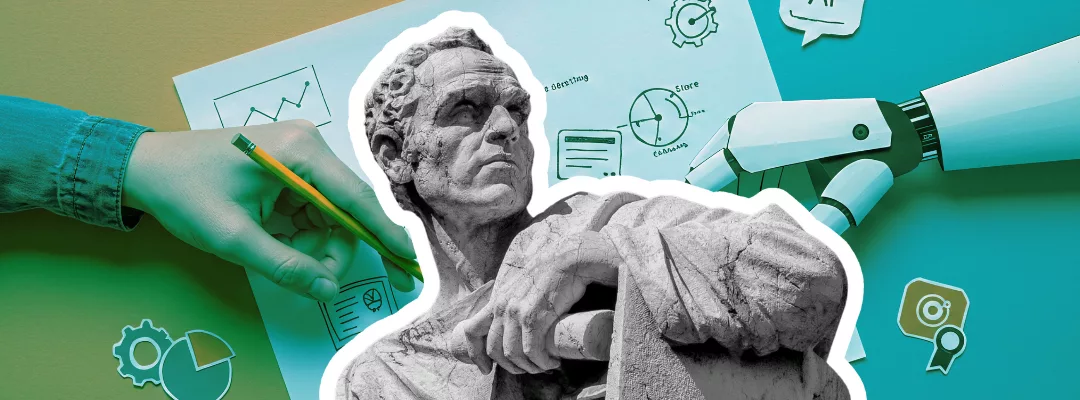
Artificial Intelligence (AI) is everywhere: it is discussed in conferences, books, university courses, and the media. Yet, despite often being perceived as something futuristic, AI is already deeply rooted in our daily lives, often in ways we are not even aware of. It is literally everywhere, both inside and outside the Internet. This leads us to wonder: how long has AI been part of our existence? Where exactly is it found? And why does it spark fear in so many people?
Before addressing these questions, it is necessary to clarify what exactly we mean by Artificial Intelligence. Telling its history—which dates back at least to the 1940s, or even to 1642 with Blaise Pascal and his first calculator—would require a much longer article. The same applies to explaining its technical foundations: neural networks, the differences between machine learning and deep learning, algorithms, and mathematical models. These are all concepts that, for a non-expert, would require a much broader discussion.
Returning to the “basic” meaning of the term, AI is generally described as a large “umbrella” that gathers a set of techniques capable of processing data, making predictions, and taking decisions. More technically, it is “a branch of computer science that allows the programming and design of both hardware and software systems that equip machines with certain characteristics typically considered human, such as visual, spatio-temporal, and decisional perceptions” (1). In other words, it is a technology that allows computers and machines to simulate a form of human learning.
Even without realizing it, anyone who uses a smartphone, a computer, or browses the web interacts with AI daily. Social platforms—Facebook, Instagram, X (formerly Twitter)—rely on algorithms that analyze our activities to create profiles, show us relevant content, and offer personalized advertisements, which are fundamental to their economic functioning. The same happens on e-commerce sites like Amazon, and in music (Spotify), video (YouTube), or film (Netflix) streaming services. Even satellite navigators use AI algorithms to calculate the best route.
From Science Fiction to Reality
Before the spread of generative systems like ChatGPT, the collective imagination was still strongly influenced by science fiction films, which relegated AI to a distant future. However, the lightning-fast adoption of ChatGPT—one million users in five days, one hundred million in two months since its launch in November 2022—has made AI suddenly concrete, accessible, and almost “human”. It has changed common perception: today, many experience it as an interlocutor with whom it is possible to dialogue. It is important to remember, however, that AI does not coincide with robots. Robots are physical devices that perform actions, while AI is a processing system that, thanks to sensors (cameras, microphones, etc.), interprets data and determines decisions that robots then carry out in the real world.
Ethics, Risks, and Revolutions
The transformative scope of AI also brings risks, especially of an ethical nature. Our privacy is constantly tested: we provide personal data “for free” in exchange for services that are not, in fact, free. Then there is the issue of algorithmic bias and discrimination: being trained on human data, AI inherits and can amplify our biases. One of the most concerning problems with systems like ChatGPT is the tendency to “hallucinate,” i.e., generating false but plausible information. This is not because it wants to lie, but because it sometimes invents. Added to this are deepfakes: false but extremely realistic images, videos, or audio that can be spread with alarming speed, with very serious consequences for information and democracy. One only needs to recall the image of Pope Francis in Balenciaga clothes or the fake photos of Donald Trump’s arrest.
However, to avoid falling into what Umberto Eco defined as the “apocalyptic”, we cannot ignore the revolutionary applications that AI has brought. In medicine, for example, the AlphaFold project has created the largest database of protein structures ever made. AI supports the early diagnosis of skin tumors and has contributed to the discovery of new antibiotics such as halicin and abaucin.
“Conclusion”: A Spiritual and Human Perspective
How has the Church positioned itself in the face of all this? In his message for the 2024 World Day of Peace, Pope Francis wrote that “Artificial Intelligence will become increasingly important”. The challenges it poses are technical, but also anthropological, educational, social, and political. These issues must “make us reflect on an aspect so often neglected in the current technocratic and efficientist mentality, yet decisive for personal and social development: the ‘sense of limit’.”
In his message for the 58th World Communications Day, Pope Francis asked: “What then is man, what is his specificity and what will be the future of this species of ours called homo sapiens in the era of artificial intelligences?” In an era dominated by technology and poor in humanity, he invites us to return to the human heart and develop a spiritual gaze. Only a “wisdom of the heart” allows us to understand our time and rediscover a truly human communication capable of uniting what is often separated.

Pope Leo XIV, in his message to the AI for Good Summit 2025, reaffirmed that technological progress cannot be separated from respect for man. AI must be guided by ethical principles and centered on human dignity. There is always the risk that man, in an attempt to overcome his vulnerability through technology, falls into the ancient temptation of wanting to become “God without God”. Another risk is the reduction of the person to data, transforming reality into a series of numbers and losing sight of the uniqueness of each individual.
AI is a powerful tool: like a hammer, it can build or destroy. Everything depends on the awareness with which it is used and the sense of limit of those who hold it. Without a human and ethical orientation, technology can become an instrument of dominance and aggression.
Discover more from Tamang Usapan Podcast
Subscribe to get the latest posts sent to your email.